“We arrive on a grey, filthy day in spring. The war doesn’t care.”
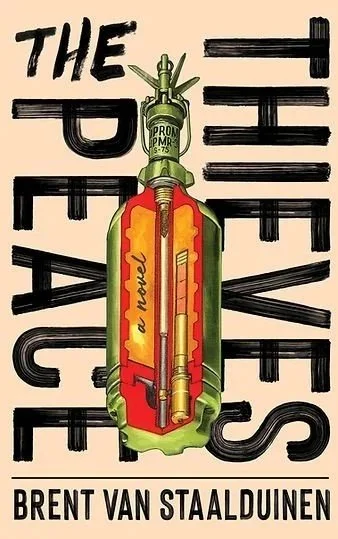
Brent van Staalduinen wastes no time opening his novel Peace Thieves, plunging the reader into the Croatian War of Independence as experienced by Canadian reserve combat medic Francis Kloet. From the “long and boring” Air Canada flight filled “with plenty of crappy food and empty hours” to driving “the Camper”, “basically a Chevy pickup with an ambulance bolted to the chassis”, and then Kloet’s “true baptism to the war”, witnessing an exploding landmine that obliterates a farmer and severely wounds his cow. Kloet wants to stop and help. Master corporal Mackey, his ambulance partner and superior, responds to keep on driving with the terse statement that encompasses this novel: “Not our war.”
All that in the first two pages.
With Peace Thieves, van Staalduinen captures the intensity of wartime military experience. The intensity of fear, of battle, of boredom, of pain, while also being as anti-military as the American classics Catch-22 and Slaughterhouse Five — but without the satire. This novel’s tone resides within scenes of the grit of the war zone and the grit of hardscrabble lives when the soldiers return home. In this way, van Staalduinen unites his prose style with his narrative. Peace Thieves embraces the individual soldier, both during the war and thirty years later, showing Kloet as he continues to recover from the experience, supports other surviving veterans, and counts on their support. The majority of chapters are structured around alternating timelines. The “Francis” titled chapters provide his first person narration of 1993 Croatia. In 2023, the “Viva” chapters are third-person through the point-of-view of the thirty-year-old daughter Francis Kloet never knew he had. A daughter conceived during a sexual fling when he returned home from Croatia for a short compassionate leave.
That contemporary setting is Hamilton, Ontario, where Kloet has taken over his father’s bar, St. Mike’s, a gathering place for struggling vets. Viva, after the death of her mother, has travelled from Winnipeg to find her father. Winnipeg and Hamilton like Canadian twin-cities, tough working-class towns, their once vibrant cores filled with unhoused citizens coping with mental health issues. Kloet’s daughter is a warrior in her own right, a veteran protester fighting for social justice, with a tattoo sleeve of “unified pieces” “like a collage” of her “adult life”. The reader quickly understands her adult life has been dominated by these protests, these battles. But what do the battles achieve? What is our war? In the end, maybe that’s not the question because it implies there can be a victory. Perhaps: what are our actions? With this answer: the best an individual can do is to take a stand.
Winnipeg also serves as a plot point in the narrative, a planned reunion of veterans who fought in the Battle of Medak Pocket. There Canadian Peacekeepers engaged the Croatian Army as warriors, not peacekeepers, and it is recognized as the most significant fighting by Canada’s military since the Korean War. The Korean War serves as a marker, after which time the country’s shrinking military took its outdated equipment into the new tradition of peacekeeping. As the son of a Korean War veteran, Kloet connects these traditions, Canadians as fierce soldiers of two World Wars becoming world-recognized by their blue helmets during the Cold War. Former seminarian Kloet enters the military as a reservist looking to do some good in life but is thoroughly confused by what that might be. A literary novel, Peace Thieves is driven by character not plot. Often we know events before they happen and the suspense is not the anticipation of the event but in how the characters will react, how they will behave. Early in the novel we realize Kloet lost a foot in Croatia but it’s not until near the end of the novel that van Staalduinen paints that incident’s scene. The contemporary Hamilton chapters show us how Kloet has coped — or not — with that loss and what he witnessed in Croatia. Just as we see how his daughter Viva copes — and does not — with finding her father in Hamilton, mourning her mother, and trying to understand her life as much as her father tries to understand his own.
While this novel is not satire it does explore the military’s absurdity. The wounded cow in the opening pages was also pregnant, and the hole that the landmine blast ripped open exposed an unborn calf who will die along with its suffering mother. Against regulations, and defying master corporeal Mackey, Kloet shoots the cow. Back at base, after reports are filed, the soldier is charged with the “unauthorized discharge of his weapon” and for “wasted ammunition”, punished with an assignment of extra-duties. His captain tells the soldier he needs “to think about staying straight”. Soldier Kloet reflects on that directive: “Seems about right that the army thinks of mercy bullets as a mistake rather than a kindness.” That too entangles with this novel’s themes. As an individual decides when to take a stand they must also sort out the mistakes from the kindnesses.
A Review of Peace Thieves by Brent Van Staalduinen
Author: Brent Van Staalduinen
Genre: Fiction
Publisher: Thistledown Press Published: 2026
Pages: 348
Ed Seaward’s novel London Gothic will be published by DarkWinter Press in October, 2026. His debut novel Fair was published in 2020 by The Porcupine’s Quill. Profiles From The Bright Side Of The Road, Ed’s web publication, features writers, actors, artists, environmentalists, family and friends. The Newfoundland family series, “It’s Sharpe to Stay Home”, was republished by Downhome Magazine. After 30 years in the corporate world, Ed now writes full-time. He and his wife Barb live in Georgetown, Ontario.