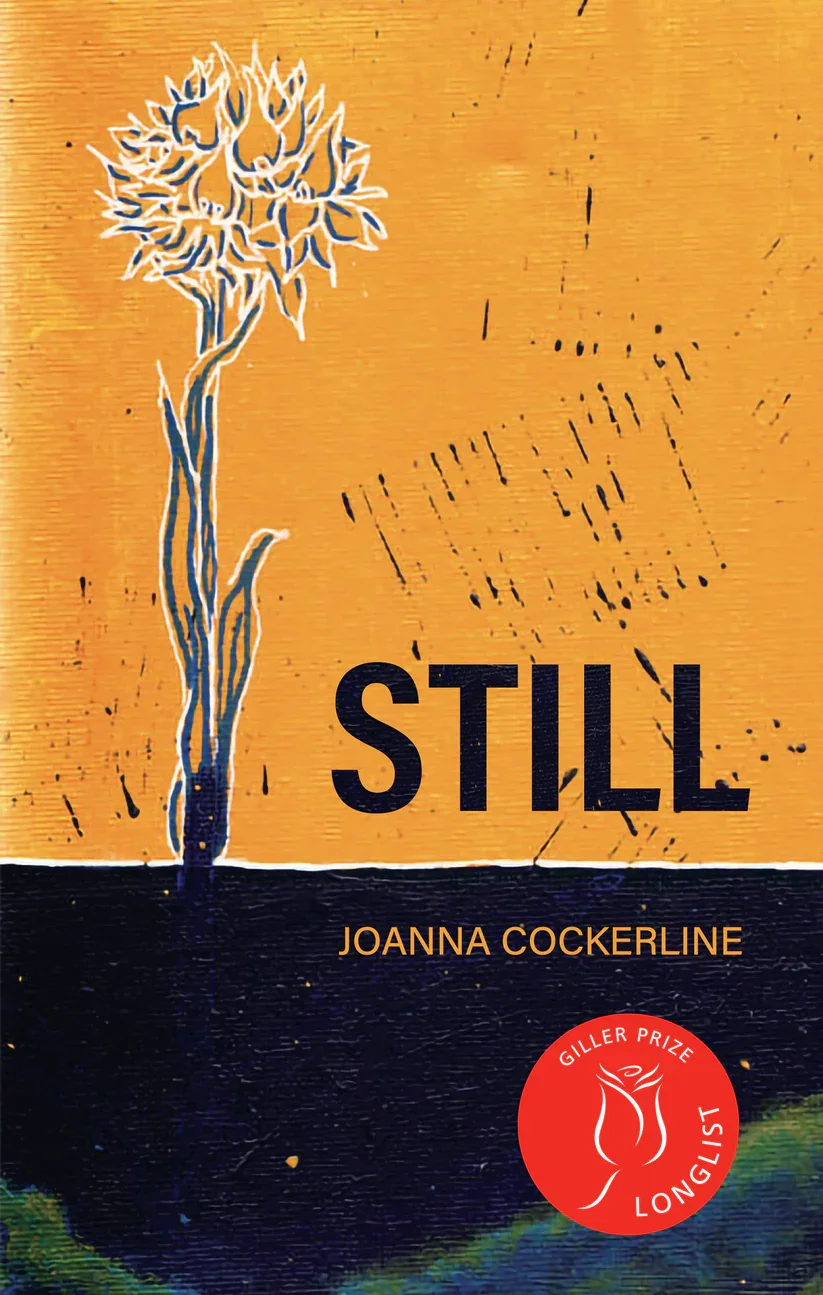
A Review of Still by Joanna Cockerline
Author: Joanna Cockerline
Genre: Fiction
Publisher: Porcupines Quill
Published: 2025
Pages: 182
“Still” means many things: the absence of movement, temporary or permanent; the ceasing of movement leading to the former; the capturing of a moment, frozen into something pictured; and, the most ironic, “still” means a continuation, often in spite of forces suggesting life should present itself a different way.
Joanna Cockerline’s novel, Still, introduces us to each of these definitions of the ‘still’. The novel, which was long-listed for the Giller Prize, follows Kayla, a sex worker working the streets of Kelowna, BC who finds her friend, Zoe, suddenly missing.
The novel begins on a Friday evening, introducing us to Kayla’s social and concrete world. Her friends have an array of backgrounds and present realities. Many live on the streets like herself, some are fortunate enough to have a semi-permanent bed in one of the shelters nearby, and others live in beautiful homes in the suburbs, commuting in daily to offer support to her and Kelowna’s other unhoused folk. Kayla, originally from Guelph, Ontario, finds herself in Kelowna after she was forced to flee. We learn, through fractured narrative, that Kayla had an unstable childhood and adolescence, and had fallen in love with horseback riding at a fairly young age when a horse farmer took her in. Slowly, in exchange for farm work, she had a bed, a space for herself, and some semblance of stability until, one evening, everything changes. She leaves in the middle of the night and descends from the bus in Kelowna.
The narrative is centred around the week following Zoe’s disappearance. Kayla first notices Zoe’s disappearance and thinks little of it. It was normal for the girls to go silent for a time if they were working. It often meant they were busy and that was mostly enough fir Kayla at the beginning. But quickly, as they enter Saturday without word from Zoe, Kayla begins to wonder, then worry, then panic as to her whereabouts and safety. Over the course of the week, we follow her through downtown Kelowna, to the suburbs, and to Hope, three hours away and back. And, since, “Memory had a way of holding her, sometimes in ways she didn’t want” (84), we often get glimpses into Kayla’s past before living and working in BC.
Cockerline offers an intimate look at the social dynamics and tensions between the street, sex work, and drug use. She never paints their relationship as a mutually-exclusive one; we are not led to believe that everyone who lives on the streets or in the shelters sells sex and uses drugs. But she also doesn’t divorce the three from one another. The relationship between these three realms is much more nuanced and interwoven, throughout both the community and across time.
Arguably the most significant and present theme throughout the novel is that of trauma. Though I don’t think Cockerline wants us to take pity on any of her characters, she wants us to understand them compassionately and as completely as possible. Each of the characters has had their own trauma and embodies it uniquely. Cockerline demonstrates how, though our trauma doesn’t define us, it can and does shape us, and at times, can envelop us. Cockerline effects this cycling between the embodied present and past through concrete language and dialogue, while leaving her readers privy to Kayla’s cerebral experiences. As time slows and accelerates in Kayla’s perception, both of the current and past, so too does the novel’s language decelerate and rev. We almost feel embodied in Kayla’s existence over the course of a week, where we follow Kayla experience traumas in the present, and relive those from her past. We also see Kayla come to understand these traumas in the greater context of her life. She asks, “When was the moment that marked the difference between having a body and being a body? What was the line between saveable and unsaveable?” (140-141) without finding any answer. There may not be one to be found.
Beyond the metaphorical and narrative elements of Cockerline’s work, all of which merit its spot on the Giller long-list, Still tactfully and deliberately brings the Canadian audience into a world most turn blind eyes to. Though selling sex in Canada is legal, much of what is logistically necessary to sell sex remains criminalized, including the purchasing of sex. This innate juxtaposition between what is legal and that which is illegal make sex work a challenging and often dangerous industry, forcing workers into the shadows where they are often left to protect themselves from the imaginable and unimaginable, which we whiteness throughout the narrative. We learn how Kayla’s community looks out for one another when and where they can. Lydia, a support worker, spends much of her time downtown brining clothes, food, and an eye out for her and the others living and working on the streets. Seasoned ladies offer advice and an ear to the younger folk learning the trade and how to keep themselves safe. Kayla does all in her power to find Little Zoe.
Still is not a narrative of resolutions. Instead, it is about the amalgam of definitions for stillness mentioned earlier. We see Kayla physically still, locked in memory, and stuck in her investigation with very little progress despite no lack of motivation nor determination. We witness her momentum cease as reality settles and time moves onward. We see life captured into stills, both physical and found and those plastered onto the mind, pulsing back up to dominate the moving, breathing, beating present. And, finally, we see this continuation, as Spring brings with it warmth, strength, and a hope that is neither delirious nor expectative, but the kind that allows us to move forward despite an era of despair and longing.
Joanna Cockerline’s Still is a novel that could earn itself a seat among Canada’s great literature. Witty, tactful, raw, and firmly rooted in the present reality of the diverse folk living and working on the street, often ignored, forgotten, expected, and abused, Cockerline doesn’t sugarcoat nor does she catastrophise. She gives a voice to an often overlooked and berated group of Canadians without sensationalization. Even at its climax, we are met with sobriety when Kayla “remembered what Little Zoe always said: know when it’s time to go” (154), before we are met with all of the meanings of stillness again, in all their deafening discomfort and peace.
Rion Levy is a writer from Toronto. He holds an HBA from the University of Toronto and teaches structured literacy. His first collection of poems, Poems of the End Times was published by Olympia Publishers in May 2023. He has published over 150 creative and non-fiction works, and has supported in the creation of 7 full-length books, 40 newspaper issues, 12 magazine and journal issues, and 4 major open-source digital humanities projects. He is most concerned with the stories we’ve already told and just what that says about us.