Interview conducted By Rachel Turney
Hanslik presents a beautiful collection of what I would call ecological-grief poetry rooted in nature and remembrance. As I read, I developed some questions related to the three unique but complementary sections of the book related to the celestial, the body, and legacy.
Turney: The first section of your book is called “From the Stars.” What does the cosmos mean to you and your work?
Hanslik: The cosmos is the most ancient thing that exists. All life is birthed from it, and to it all life returns. Because my work seeks to explain and understand the interconnectedness of all living and deceased things, I feel that the cosmos offers the most appropriate backdrop against which to position our stories. It is important in my life and in my work to retain a sense of perspective: I view myself as a small (but important) part of an integrated whole, and my work serves as a reminder of this fact.
Turney: Speaking of small and integrated parts - you use the word ‘heart’ ten times across your poems, not including the Rumi quote you chose as an epigraph. Why is this theme so important to you?
Hanslik: The heart engenders empathy and understanding. It is where we connect to all other living creatures. Without connection, there is no “us,” no “whole.” Therefore the heart is central to the experience of writing for me, because my goal as a writer is to be able to foster connection between myself and the reader, as well as between people in general. It is within the empathetic heart that we are able to converse and connect, to tell each other our stories and be heard.
Turney: You mention fossils a few times in the collection. In fact there is even a poem in the last section titled “Fossils.” Do you have a science background, or where did this imagery come from?
Hanslik: I don’t have a direct background in the natural sciences, but I have always been interested in natural history. When I was a young child, my family lived near a creek that was full of fossils, and I began collecting them from an early age. I think it fueled my imagination and gave me a sense of perspective of the vastness of time. Later, in college, I took several geology and paleontology courses, developing these interests further. It has always fascinated me to compare humans’ perception of time with the natural geological record. Prior to written language, stone was truly the only historical testimony the Earth could offer its descendants, and its records are so vast that there will always be something new to uncover.
Turney: Interesting. I also lived near a creek growing up and this is what led to my interest in geology as well. I really like the poem “Blue Body.” Tell us about that piece: what you hoped to convey and why.
Hanslik: “Blue Body” was written in 2026, but it stemmed from an idea in an earlier work I started in 2024. The first line – “My anger and the weekends promise me a justice they cannot deliver” – expresses the sense of futility I was experiencing at the time. I was pondering this idea that there’s something better waiting in the future – it seemed that my future, and my anger at the injustice of the world, continually promised me things (solutions, time, hope, clarity) that did not come to fruition. I was frustrated with the idea of hope and frustrated by my own frustration. When I revisited this line in 2026, I was overcome by a surge of empathy. I wanted to speak to my past self and tell her that I could relate, but rather than zero in on the sharp edges, I wanted to hold the smoothness—the image of water, of what it carries, and what it can cleanse and wash away. In the poem, I allow myself to be buoyed by the current, to drift and wander at will. This idea of floating through water has a natural calming effect on me; it reminds me that we can take on whatever shape and form we desire, but that sometimes that change takes a great amount of time, and the waiting requires faith and patience.
Turney: I can relate to being frustrated by frustration! What do people leave behind when they die? This felt like a theme of your work and I am wondering what your answer would be outside of the poetic.
Hanslik: People leave a psychological and metaphysical imprint when they die which persists in those who knew them. This psychological effect translates to physical results: people are forced to cope, which is as much an action as a mental state. We build monuments, tell stories, make sacrifices, pursue goals, and shape our lives and futures around those we have loved and lost, as a way to honor and remember them. Because we have no way of empirically knowing what’s on “the other side,” I find it especially meaningful that those who have passed continue to shape the future; similar to the butterfly effect, the actions of the deceased may live on and continue through the hands of their loved ones and those who carry their memory.
Turney: You mentioned butterflies, which leads into my next question perfectly. Birds are mentioned in this collection, partially in the poems about your mother. These were very beautiful and tender pieces. What bird would best represent your collection as a whole?
Hanslik: The themes of my work tend to center around the connectedness between life and death, between bodies and landscapes, the physical and the spiritual. For this reason, I’m drawn to the image of the swallow, which represents homecoming, renewal, hope, and spirituality. In several cultures, the swallow has been known for carrying souls to the afterlife and being able to travel between the physical and spiritual worlds. The swallow has a graceful, playful, musical flight pattern which embodies this sense of fluidity and freedom. It dips and dives, glides and twirls, in a joyful dance that is mesmerizing to watch. As a migratory bird, it travels vast distances and is seen as a positive omen (the return of spring) and a symbol of resilience.
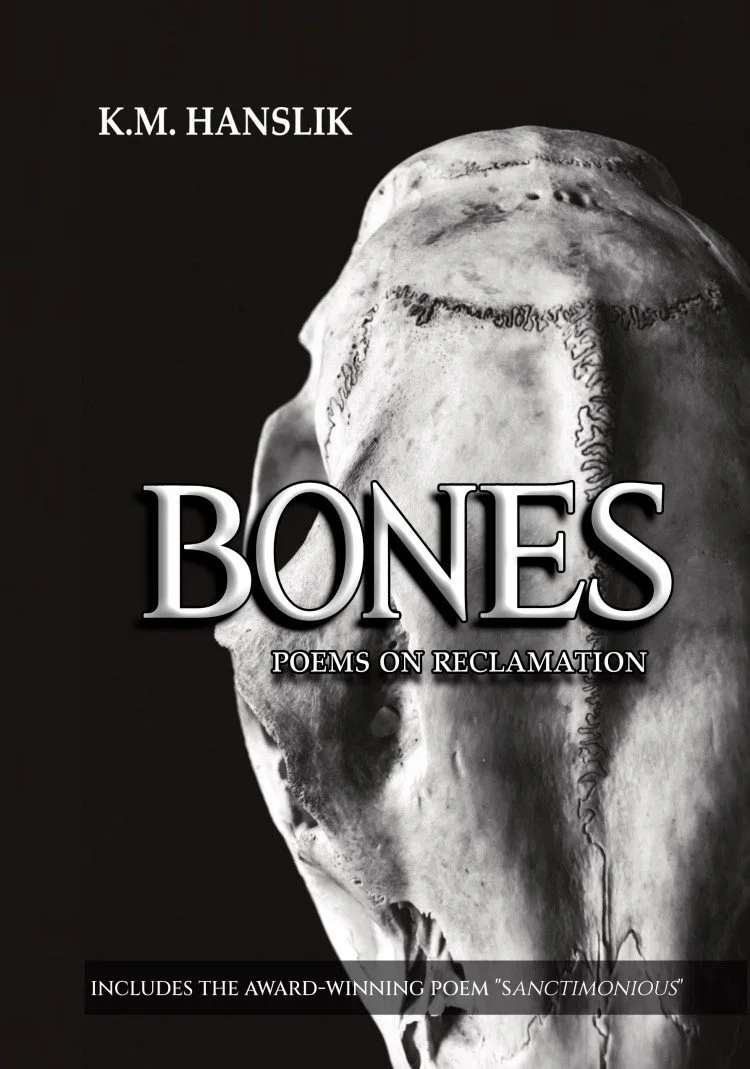
Turney: I very much subscribe to omens! Ah the swallow then is a perfect mascot for this beautiful and deep collection of poems. Congratulations on the publication of Bones: Poems on Reclamation!
About the Author:
K.M. Hanslik is an Ohio-based writer and editor. Her debut collection of poetry, Bones: Poems on Reclamation (2026) explores themes of identity, landscapes, and grief. She has been nominated for Best of the Net and featured in magazines and journals such as Rust & Moth, Half Mystic, 3Elements Review, Bleating Thing Magazine, wildscape lit, Gone Lawn, and elsewhere. She edits for The Turning Leaf Journal. In her spare time, she enjoys hiking, birdwatching, and painting. Find her on Instagram: @kmhanslik, or at her website: www.kmhanslik.com.
An Interview with K.M. Hanslik
Author: K.M. Hanslik
Genre: Poetry
Publisher: Riverstone Press Published: 2026
Pages: 69
Rachel Turney Ed.D. (she/her) is the Writer in Residence (2026) at NKollectiv in Englewood, Colorado and runs the Trident Women’s Writing Group in Boulder. She is a poetry mentor with the Association of Writers & Writing Programs. Rachel is passionate about immigrant rights, teacher support, and empowering other artists. She is a Writers’ Hour prize winner and has been nominated for Best of the Net and Best Microfiction. Rachel is the founder of the popular online reading series Poetry (in Brief) and EIC of PiB (the Magazine). She is on staff at Bare Back Magazine with her monthly column Friday Night in the Suburbs. She reads for The Los Angeles Review. Her debut poetry collection, Record Player Life (the b-side), is available with The Poetry Lighthouse. Her second poetry book, Retired Wannabe Club Kid, is out now with Parlyaree Press. Website: turneytalks.com Instagram: @turneytalks Bluesky: rachelturney